


SKU:ES-RPI-PICO2W
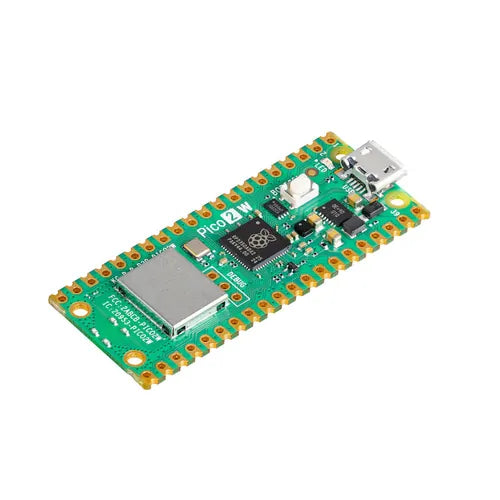
Raspberry Pi Pico 2 W — RP2350, Wi-Fi 4, Bluetooth 5.2, 520KB SRAM, 4MB Flash
Regular price
Rs.2,800.00
Sale price:
Rs.2,800.00
Regular price:
Sale:
-0%
Shipping calculated at checkout.
In stock, ready to ship
The Raspberry Pi Pico 2 W is the wireless-enabled version of the Pico 2, combining the powerful RP2350 microcontroller with an Infineon CYW43439 chip for Wi-Fi 4 (802.11n) and Bluetooth 5.2 LE connectivity. It is the ideal board for IoT projects, wireless sensor nodes, and connected embedded systems — all in the same compact, affordable Pico form factor. It is fully compatible with the Pico 2 pinout and SDK.
Key Specifications:
- Microcontroller: Raspberry Pi RP2350A
- CPU: Dual-core Arm Cortex-M33 or RISC-V Hazard3 @ up to 150MHz (selectable)
- SRAM: 520KB on-chip
- Flash: 4MB QSPI (on-board)
- Wireless IC: Infineon CYW43439
- Wi-Fi: 802.11n (Wi-Fi 4), 2.4GHz single-band
- Bluetooth: Bluetooth 5.2 LE (Classic not supported)
- GPIO: 26 multi-function GPIO pins
- ADC: 3 × 12-bit ADC inputs (500ksps)
- PWM: 24 PWM channels
- Interfaces: 2× UART, 2× SPI, 2× I²C, 24× PWM, 12 PIO state machines
- USB: USB 1.1 device and host via micro-USB connector
- Security: TrustZone for Cortex-M, signed boot, 8KB OTP
- Antenna: on-board PCB antenna
- Power: 1.8V – 5.5V via VSYS; onboard SMPS and LDO
- Operating temperature: −20°C to +85°C
- Dimensions: 51mm × 21mm
- Form factor: Castellated module
Wireless Notes:
- Wi-Fi and Bluetooth share the CYW43439 chip — they can operate simultaneously
- Wi-Fi antenna is on-board PCB type; keep clear of ground planes for best range
- Bluetooth Classic (BR/EDR) is not supported — BLE only
- Wireless drivers are included in the Pico SDK and MicroPython firmware
Programming:
- MicroPython with
networkmodule for Wi-Fi - C/C++ via Raspberry Pi Pico SDK (pico-sdk + pico-extras)
- CircuitPython (Adafruit)
- Arduino IDE (community board package)
- UF2 drag-and-drop bootloader or SWD
Applications:
- Wi-Fi connected IoT sensor nodes
- MQTT and HTTP data loggers
- Wireless home automation controllers
- BLE beacons and proximity sensors
- Cloud-connected data acquisition systems
- Wi-Fi enabled robotics and remote control